
Two sets of pictures with horse boxes, since updated and moved into the topic "Horse and Race Traffic" with a sub-section focusing on LMS horse boxes.
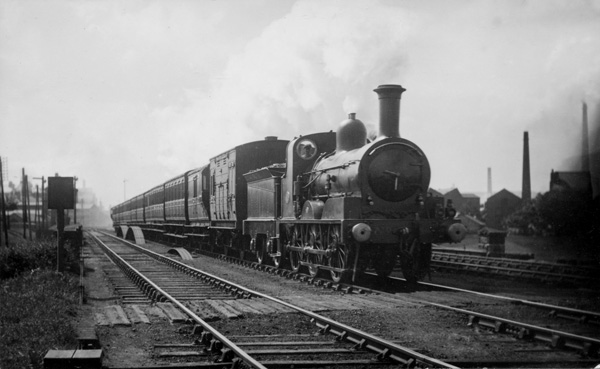
This is LGRP 21135 and shows a NBR-built Wheatley 0-6-0 approaching Carlisle with a train of 6-wheel and bogie passenger carriages; a 4-wheel passenger brake van; and a horse box. The headlamps are not RCH-related but a local one so I cannot tell if this was an express or ordinary passenger train. I suspect that the code probably indicated the route being served, a practice which lasted beyond the Grouping in several parts of the UK.
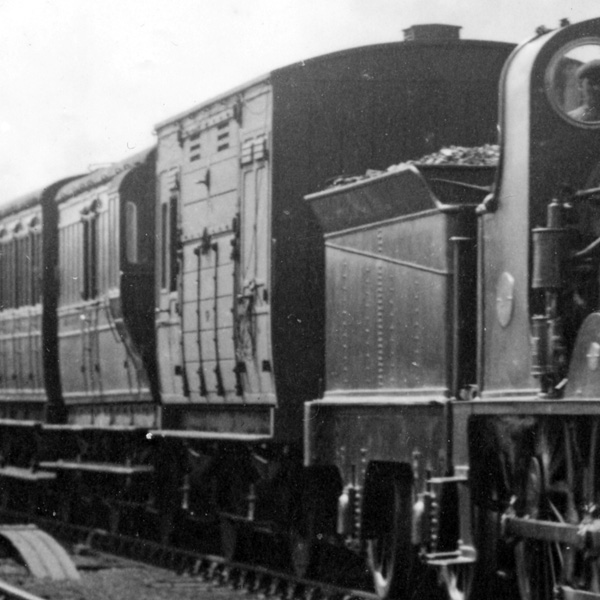
An enlargement of the two non-passenger vehicles shows more of the horse box. Oil axleboxes are evident, a fixture that was becoming normal on coaching stock built after around 1900.

The second view shows an LMS train in 1925 at Blackwell being banked up the Lickey Incline. 2P 4-4-0 No 521 has an Ordinary Passenger train comprising four bogie carriages, mostly clerestory, flanked by vans: ex-Midland Railway 6w at the front and on the rear, ex-LNWR, still in LNWR livery, a common sight during the 1920s. Behind the loco, however, are five horse boxes.

The trailing three are indistinct but look like Midland Railway designs, of which there were several different types, both flat-sided and with tumblehome, arc roof and elliptical. At the head there are two more examples of the mystery design.
In Peter Tatlow's "Historic Carriage Drawings, Volume Three, Non-passenger Coaching Stock" (Pendragon, 2000), page 75 shows a Maryport and Carlisle horse box, No 4, which Peter concluded was the sole survivor listed in the LMS renumbering in 1932. The body profiles are similar and there are several similarities in detail.
Philip Millard, well known for his LNWR researches, has come forward to identify the mystery design in both pictures so I have trimmed my thoughts and quote Philip thus:
"A considerable number of these 21ft boxes was built by the LNWR to Diagram 436. In all, 692 were produced between 1890-1923 and the ones at Blackwell are earlier examples built on steel channel frames with rounded ends to the headstocks. They have the 1901 pattern of oil boxes. The first one is a pre-1896 example with horns outside the solebars. The second appears to be post-1896 with horns inside the solebars.
The one at Carlisle is a later, post-1899 build on bulb-iron frames with square-end headstocks, and it too has oil boxes, of the 1916 type.
There were still about 699 of these horseboxes in capital stock at the Grouping, and 247 in 1933. The type did not become extinct until 1954".

At this point it's fair to show the preceding LNWR Diagram 438 to 19'6" because it is covered by London Road Models, whose illustration is shown above. The website states that this Diagram had been built between 1883-1889. 150 were constructed, 88 of which were still running in 1915. By 1920 they had all been replaced by the newer design. London Road Models can be found via the Useful Links section in the main menu.
As regards M&CR horsebox No 4 which was built in 1904 and shown in Peter Tatlow's book, although built by R.Y. Pickering of Wishaw near Motherwell in Scotland, it appears to have been based on contemporary LNWR designs with a few simplifications, such as one less door to the fodder compartment.
Click on the image for an enlargement
Workings - All of which brings us back to the train pictures and possible workings. Philip Millard tells me that there used to be a weekly sale of horses at Crewe, to and from which horses would be sent by rail. The LNWR would have despatched using its own boxes, and after the Grouping, ex-MR ones too. There were other sales, of course, around the country in the same way that second-hand cars are traded these days and I'm wondering if the ex-MR and ex-LNWR horse boxes at Blackwell were part of a sale, at Gloucester, for example, or possibly empty boxes being returned? I think that race traffic can be ruled out.

