
Coal traffic
Reorganised.
This is now in 6 sections:
Introduction From colliery to marshalling yard Between marshalling yards Delivery by pick-up goods Transition for wooden wagons to the steel mineral Grades of coal
1 - Introduction
There is a lot of information about wagons and collieries: this is an attempt to describe three kinds of traffic and what they actually looked like:
- from colliery to marshalling yard - across country between marshalling yards - from marshalling yard to wayside stations.
The first leg was often called a trip working.
The second was usually a long distance through working under Class C lights. This category ran at the slowest speed and included all-coal trains (or empties). There were also Class C through goods of a more mixed variety.
The third leg was what might be called "local" pick-up goods under Class D lights.
I'm going to show examples of all three kinds and how the loads changed over the years. Many modellers seem to think that only 7-plank wagons were employed and the trains were totally uniform. I'm going to show how early coal (or "mineral") wagons were much smaller and once in service, they lasted a great many years. A high degree of uniformity was never established until after steam haulage had ended, the immediately preceding 1960s looking very uniform thanks to the steel mineral wagon. Although the more knowledgable among us can show how this type developed in the late 1930s and oh-so-many slightly different types followed. It's best to take a chronological look at the traffic
2 - From collieries to the marshalling yards
I don't have many of these views through not having researched the colliery areas too much.
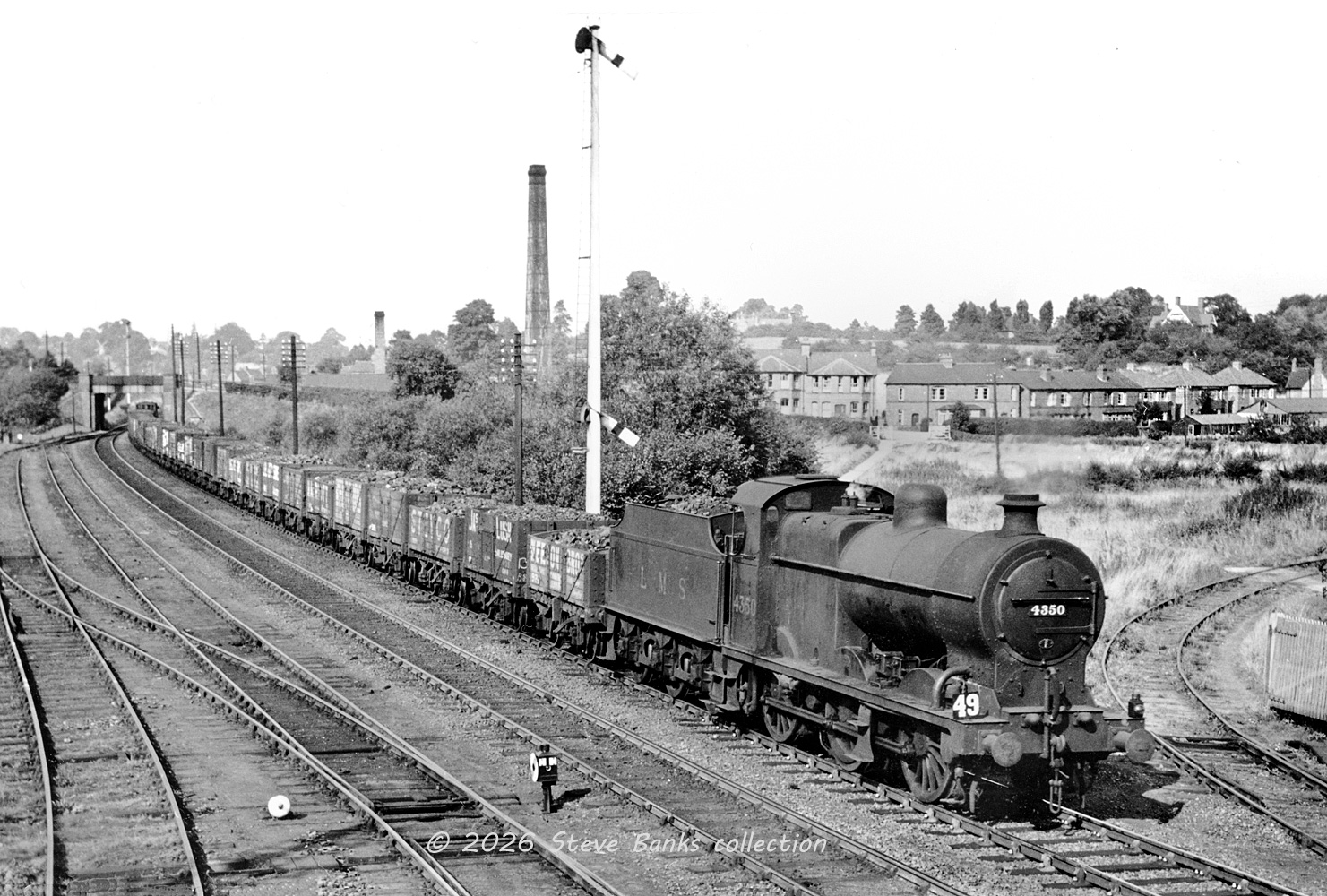
An LMS view from 1938 near Kenilworth with 4F No 4350 in charge of what looks like a trip working of around 25 wagons with the leading ones identifiable as:
3-plank |
- |
4-plank |
- |
5-plank |
5 |
6-plank |
1 |
7-plank |
4 |
8-plank |
- |
In this train, some 60% 0f the wagons are 5- or 6-plank. In other words, only about 40% are 7-plank - older wagons still dominated the traffic. It's also worth noting that the leading three wagons don't have end doors: only side doors. Photo: Gordon Coltas.
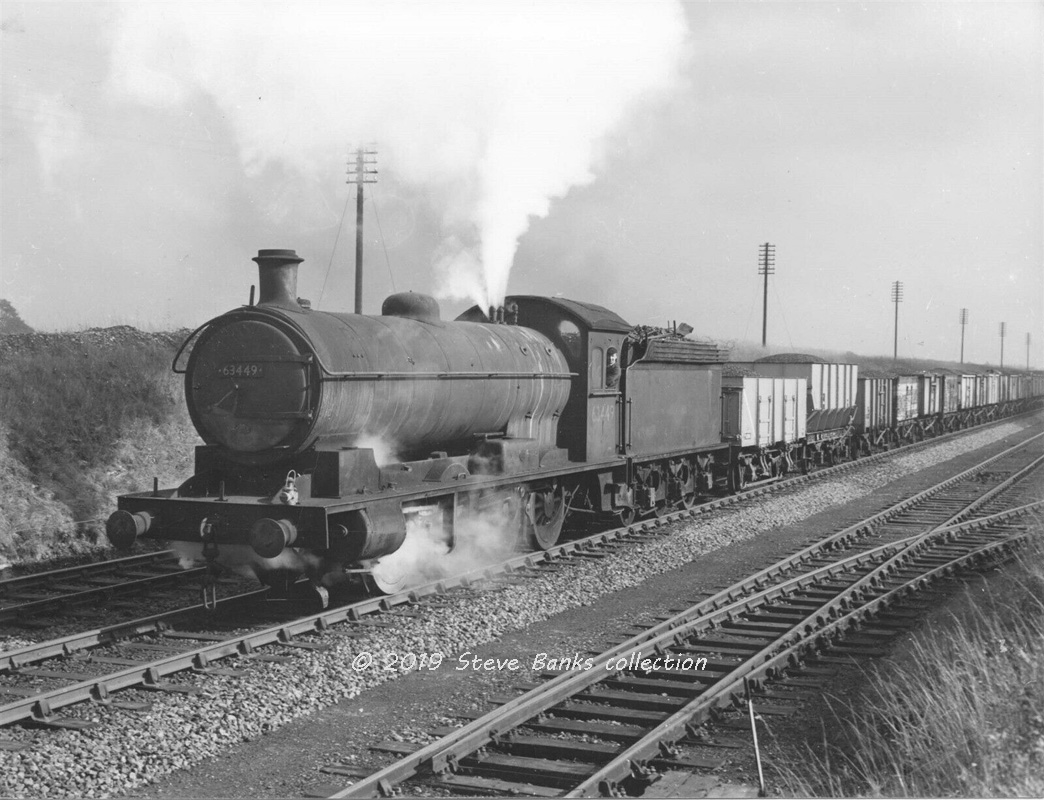
This example from the 1960s was captured near Leeds on a trip working from Peckfield Colliery to Neville Hill. One of its Q6 0-8-0s No 63449 is in charge, the usual motive power for these workings, carrying Class 9 unfitted lights (what used to be a "pick-up" goods). Coal concentrated at Neville Hill was on the NE Region so it is no surprise to see both wooden and steel mineral wagons with 2 and 4 doors and a heavy hopper design. The photograph is not dated but this Q6 was at Neville Hill from 12/59 to 7/63. Photo: author's collection.
Click on the image for an enlargement
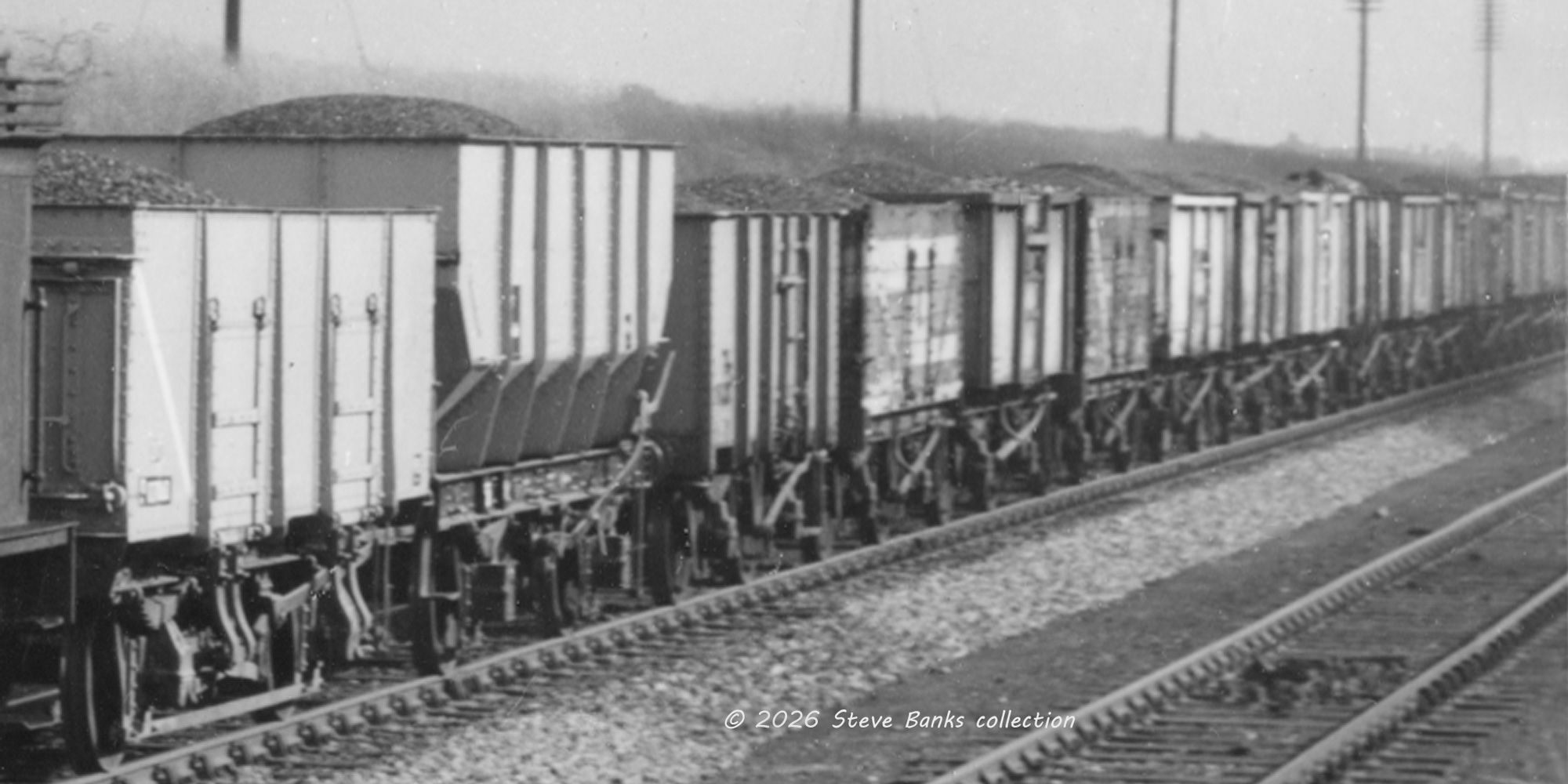
A closer view of the mineral wagons in the train showing the variety of types.Three of the 15 wagons are still wooden 7-pl and 8-pl types (20%). The nearest places with NER-style coal drops where hopper wagons could be used were not far away on the Wetherby branch.
Click on the image for an enlargement
3 - Between the marshalling yards
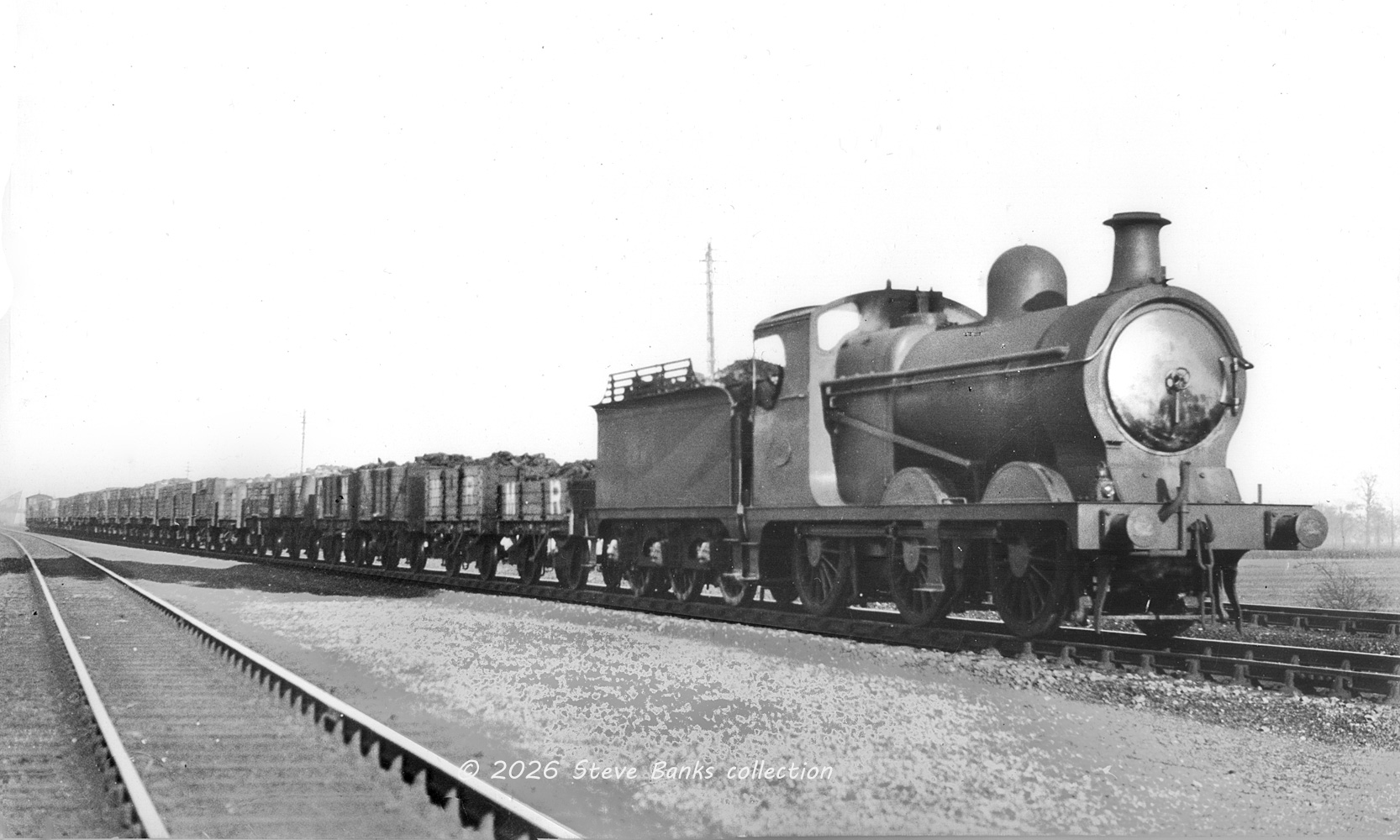
The first example is undated but my estimate would be c1923 around the Grouping. Seen near Leicester a class C train is headed by GCR-built Class 9F (later J11) No 1046 and the variety of wagons is mind-boggling. The identifiable types in the first thirteen are:
3-plank |
1 |
4-plank |
1 |
5-plank |
4 |
6-plank |
3 |
7-plank |
4 |
Yup, that's 5 different kinds! And they are a mixture of privately owned and railway company wagons. Photo: LGRP No. 16187.
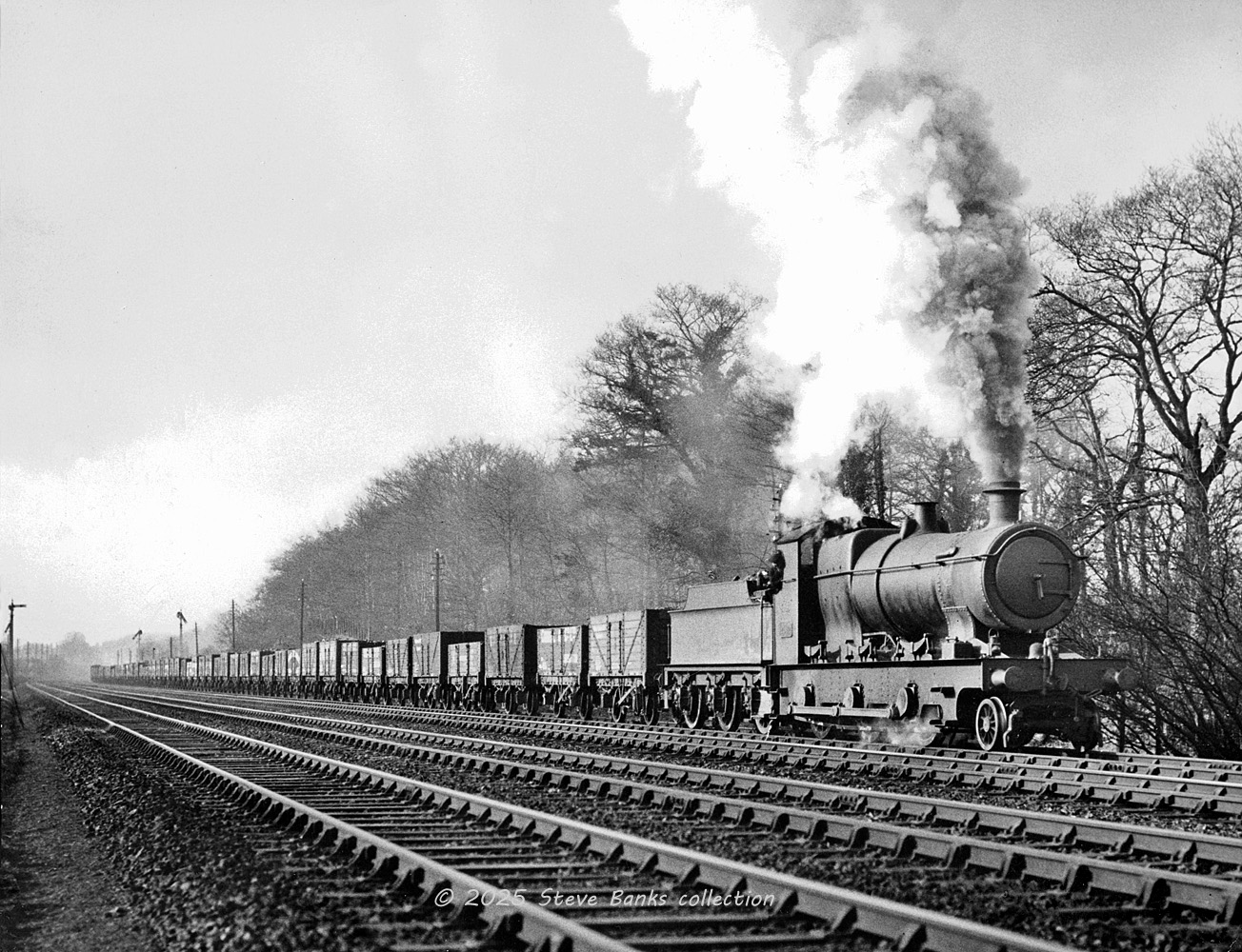
This is 1927 and an Up GWR train in the Thames valley near Twyford headed by "Aberdare" 2-6-0 No 2662 and every identifiable wagon still has grease axleboxes: .
3-plank |
- |
4-plank |
- |
5-plank |
2 |
6-plank |
2 |
7-plank |
5 |
8-plank |
1 |
The huge variety of wagons is clearly visible here too and though the proportion of 7- and 8-plank wagons is higher, 40% of the wagons are still 5- and 6-plank. Photo: Maurice Earley.
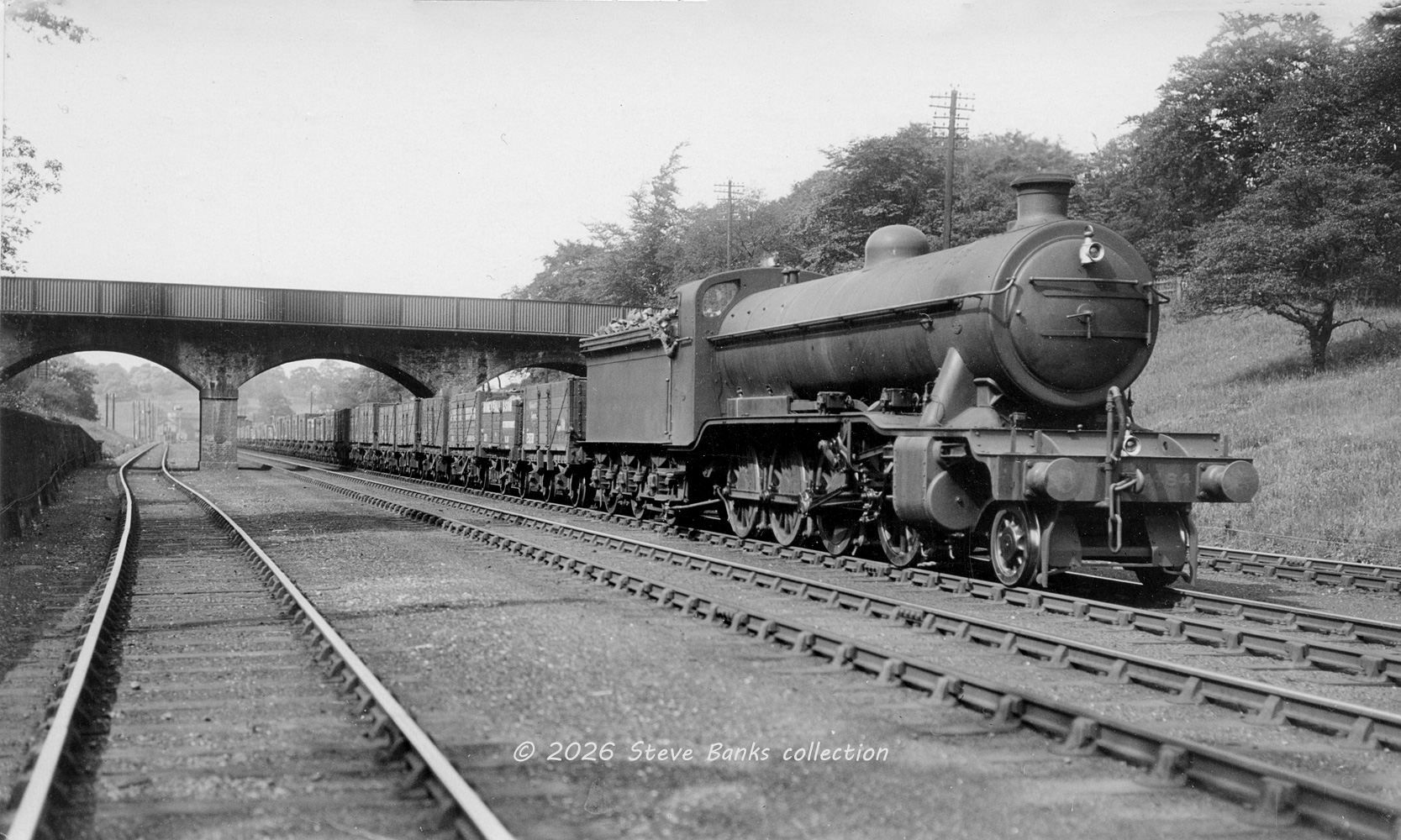
A classic coal train from between the Wars. It's May 1930 at Hadley Wood as 02 No 3484 approaches London carrying Class A goods (30mph) lights. The train is headed by about 25 coal wagons of which the identifiable ones are:
4-plank |
- |
5-plank |
7 |
6-plank |
1 |
7-plank |
8 |
8-plank |
- |
As can be seen half of the wagons are still relatively old mainly 5-pl and the odd 6-pl. The other half is made up with more modern 7-pl wagons. G.H. Manillieu, LNER Official TF/73.
Click on the image for an enlargement
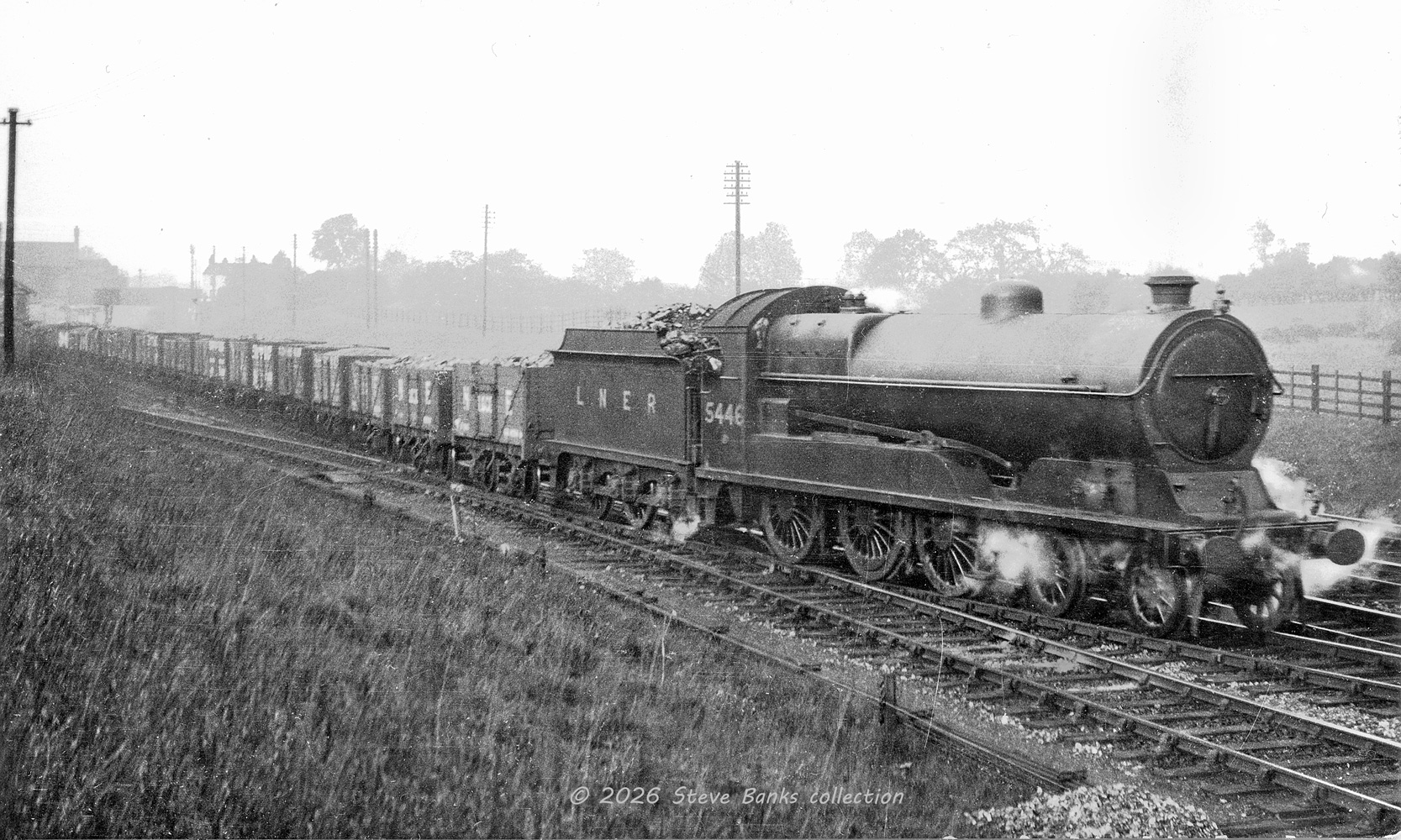
My apologies for a less than sharp image on a dank day but this photograph from the late 1930s at Rugby Central shows B8 4-6-0 No 5446 Earl Roberts of Kandahar (ANN) on an accelerated Up Class A coal train at Rugby Central, possibly the 12.20pm from Annesley in which the leading three wagons stand out:
7-plank |
LNER COAL |
6-plank |
LNER COAL |
6-plank |
LNER COAL |
This leading trio was destined for Woodford Loco's coaling stage, or possibly Neasden's. The train appears to be backing onto the Down main line, possibly because the Up layby wasn't available or because the curves were gentler and could be taken more swiftly. Photo: author's collection.
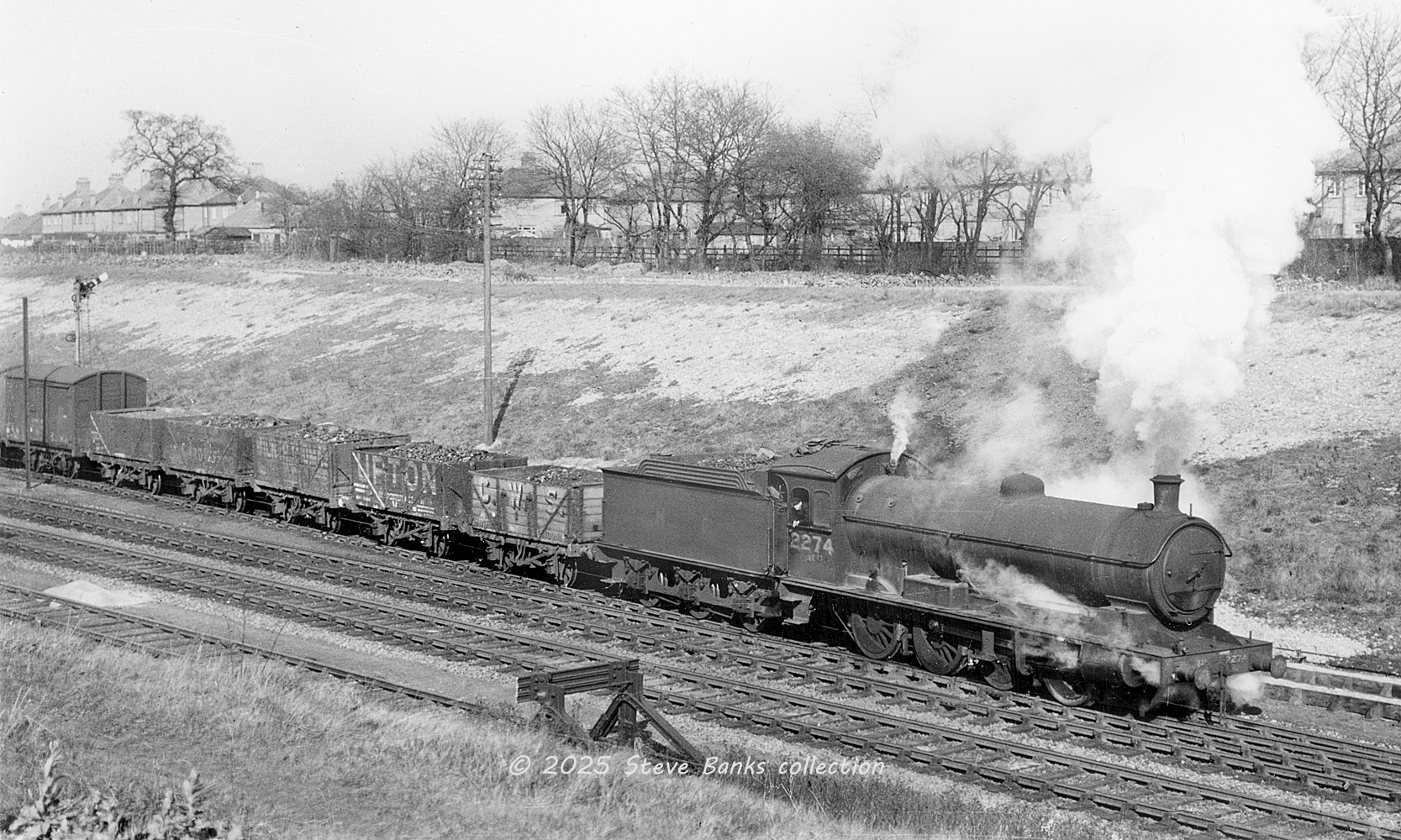
This undated picture at Rugby Central of a Class C goods hauled by ex-NER Q6 0-8-0, No 2274, I would date as 1943 when it was allocated to Neville Hill and would have been working a train from York or Neville Hill to Woodford Halse, a working usually handled by a 4-6-0. A couple of covered vans can be seen and five coal wagons, several identifiable as West Riding collieries such as Upton and Silkstone. The CWS wagon (Co-operative Wholesale Society) could have come from a colliery in the NE but was probably serving one of the society's many industrial concerns with Yorkshire coal.
At least one 6-plank wagon can be seen and several different grades of coal. Photo: AWV Mace collection.
4 - Delivery by goods pick-up
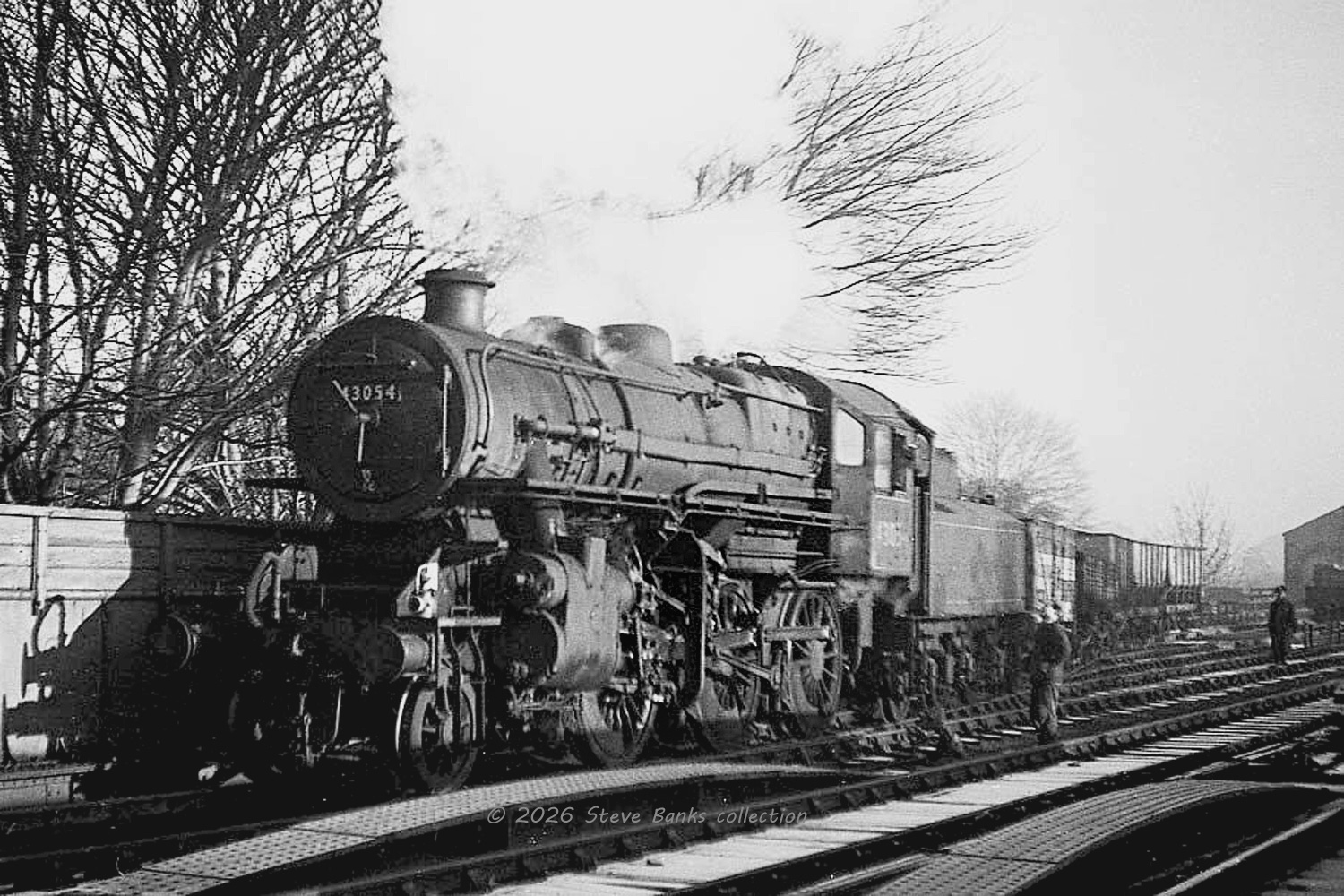
Seen in 1961, a pick-up goods from Neville Hill at Wetherby is being shunted by ex-LMS Ivatt 4MT 2-6-0 No 43054 (NEV) as it sets back to position steel hopper wagons over the coal drops. The wooden wagons behind the tender will be drawn forward and placed in other sidings. Author's collection.
Click on the image for an enlargement
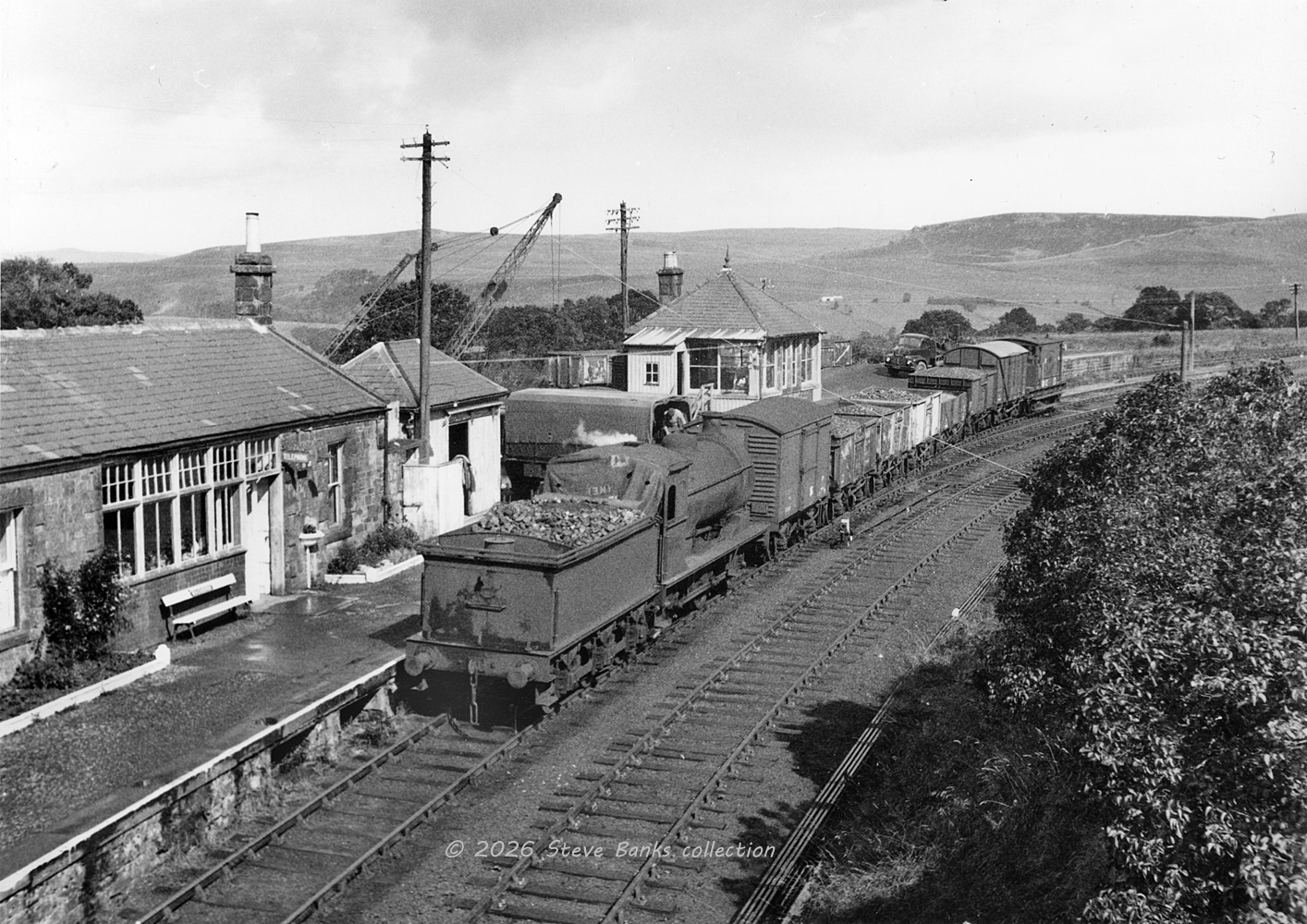
This view at Woodburn in Northumberland is another example of late BR changes in pick-up traffic where much had declined but the coal had held up. The picture is dated "1965" but by then weeds were rampant - I think this is nearer to 1961 when this loco was at North Blyth. Several coal wagons can be seen behind the station and J27 No 65869 is on the Thursdays-only pick up, down to 7 wagons of which 4 are steel minerals carrying several varieties of coal and a fifth looks like a merchandise wagon loaded with sand. Photo: Neville Stead.
Click on the image for an enlargement
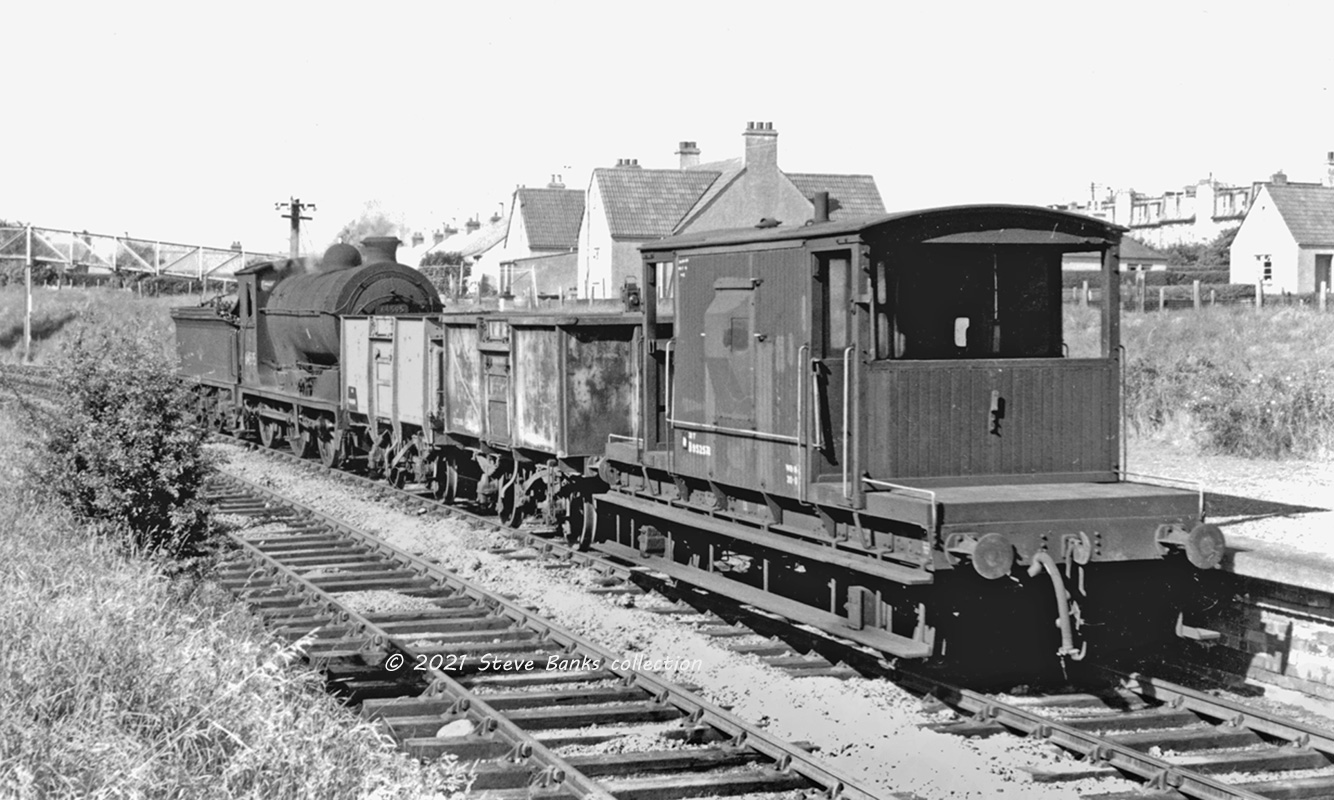
A fine view in May 1962 of ex-NBR J37 No 64595 of St. Margarets in Edinburgh at Kirkliston, ten miles west of Edinburgh on the South Queensferry branch shunting the daily goods pick-up and two coal wagons, which by this time was often the principal traffic, this station having become the local railhead for coal. Photo: G. Harrop.
Click on the image for an enlargement
5 - Transition from wooden to steel mineral wagons
Having mentioned that steel mineral wagons were introduced during the 1930s and their numbers increased through all the years that followed, until eventually all the wooden wagons had gone, but not as far as I can tell, till after the end of steam. It is possible to look at a lot of photographs of coal trains and analyse what the proportions were of wooden vs steel mineral wagons but it's complicated by regional variations and many coal train photographs being undated. Here are some examples from the BR period:
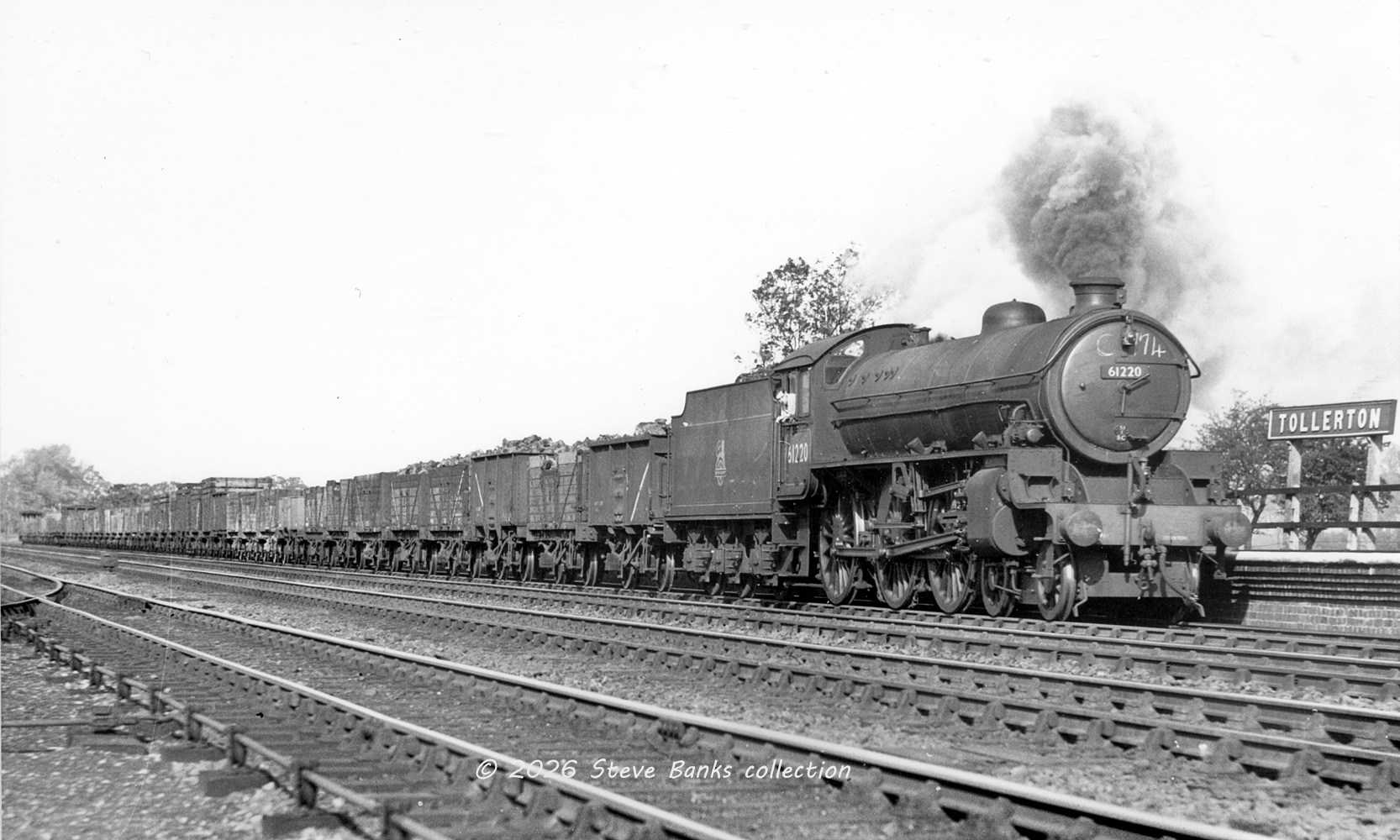
A relatively early undated BR view at Tollerton near York with B1 No 61220 in charge. This loco was at Stockton 1947-59 and my estimate would be c1950. The lights being carried would be either: 1947 - Code 7 freight (25mph) 1950 - Code H - freight (slow)
Either way, this was the slowest category of through freight with half a dozen miscellaneous goods types on the rear and 22 coal wagons leading of which these can be identified:
5-plank |
- |
6-plank |
1 |
7-plank |
5 |
8-plank |
3 |
with height extension for coke |
5 |
steel mineral |
2 |
steel merchandise |
1 |
The proportions are thus:
wooden wagons |
83% |
steel wagons |
17% |
Which looks fairly typical for early BR days, still dominated by wooden wagons with few signs remaining of private ownership and only a few having gained a diagonal white stripe to indicate the end door, others not yet. A.J.Ludlam collection.
Click on the image for an enlargement
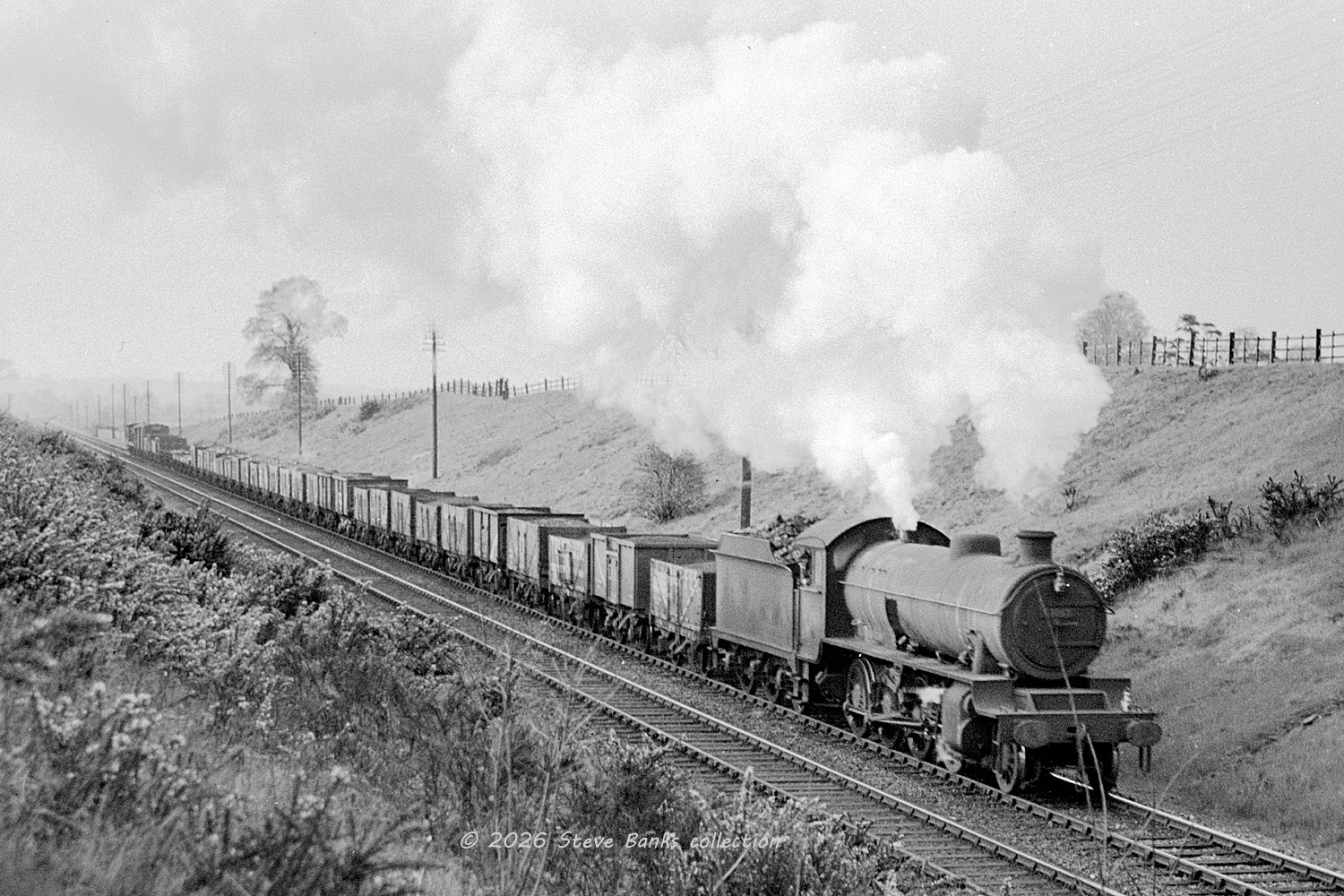
This view shows O1 No 63663 (ANN) in 1952 a mile south of Lutterworth on the descent to Rugby and Braunston where there was a brief climb at 1:176 and locos would open up: quite a good location for photographers. The train captured is a cross between the accelerated coal trains and post-WW2 expansion to many goods trains which combined a decent length of coal traffic ahead of a dozen normal goods types running under Code F "express goods, unfitted" lights between the yards at Annesley-Woodford Halse. This was the period when the nicknames of "runners" and "windcutters" between these two yards was born. The actual wagons are:
26 coal |
12 misc goods |
The coal wagons break down as:
7- & 8-plank |
22 (85%) |
steel mineral |
4 (15%) |
Which is pretty similar to the previous photo of c1950 and still a very high proportion of wooden wagons although all are 7- and 8-plank which were now rated as 12T. The proportion of more recently built 16T steel mineral wagons is, as yet, quite small - this was to change more swiftly than on other parts of the BR system. Photo: author's collection.
Click on the image for an enlargement
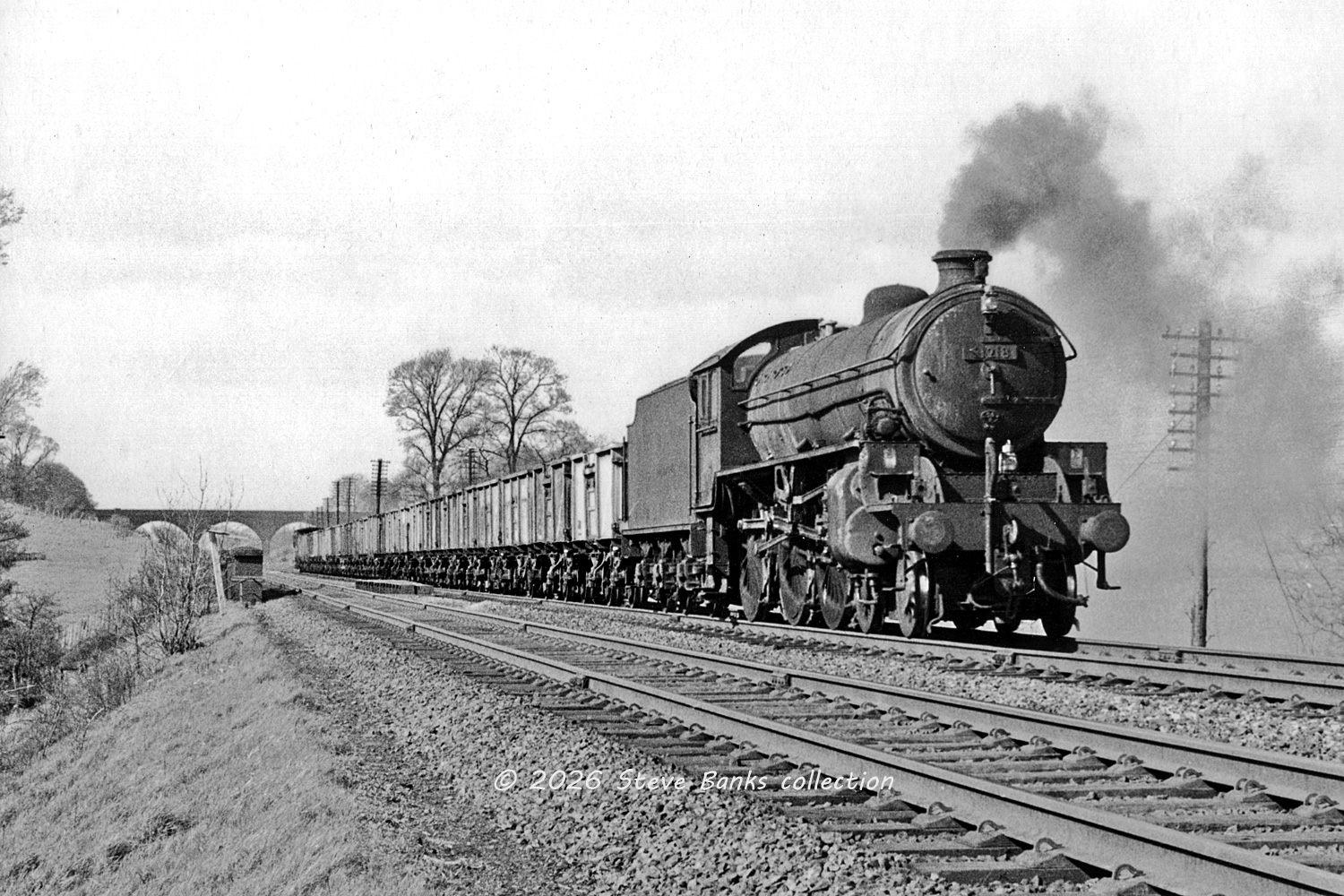
Believed to date from c1963 this pictures shows B1 No 61218 on the GCLE between Annesley and Woodford Halse, actually a few miles south of Rugby Central. The loco's allocation between 11/1962 and 7/1965 was Ardsley so it isn't possible to tell if this train contained Yorkshire coal or from collieries around Annesley.
25 steel mineral wagons of various kinds are being carried behind Class 8 lights for an Express Freight with the lowest amount of braked wagons - probably none at all. This would have been one of the GC Section's accelerated coal trains behind a 4-6-0 mixed traffic loco. Photo: author's collection.
Click on the image for an enlargement
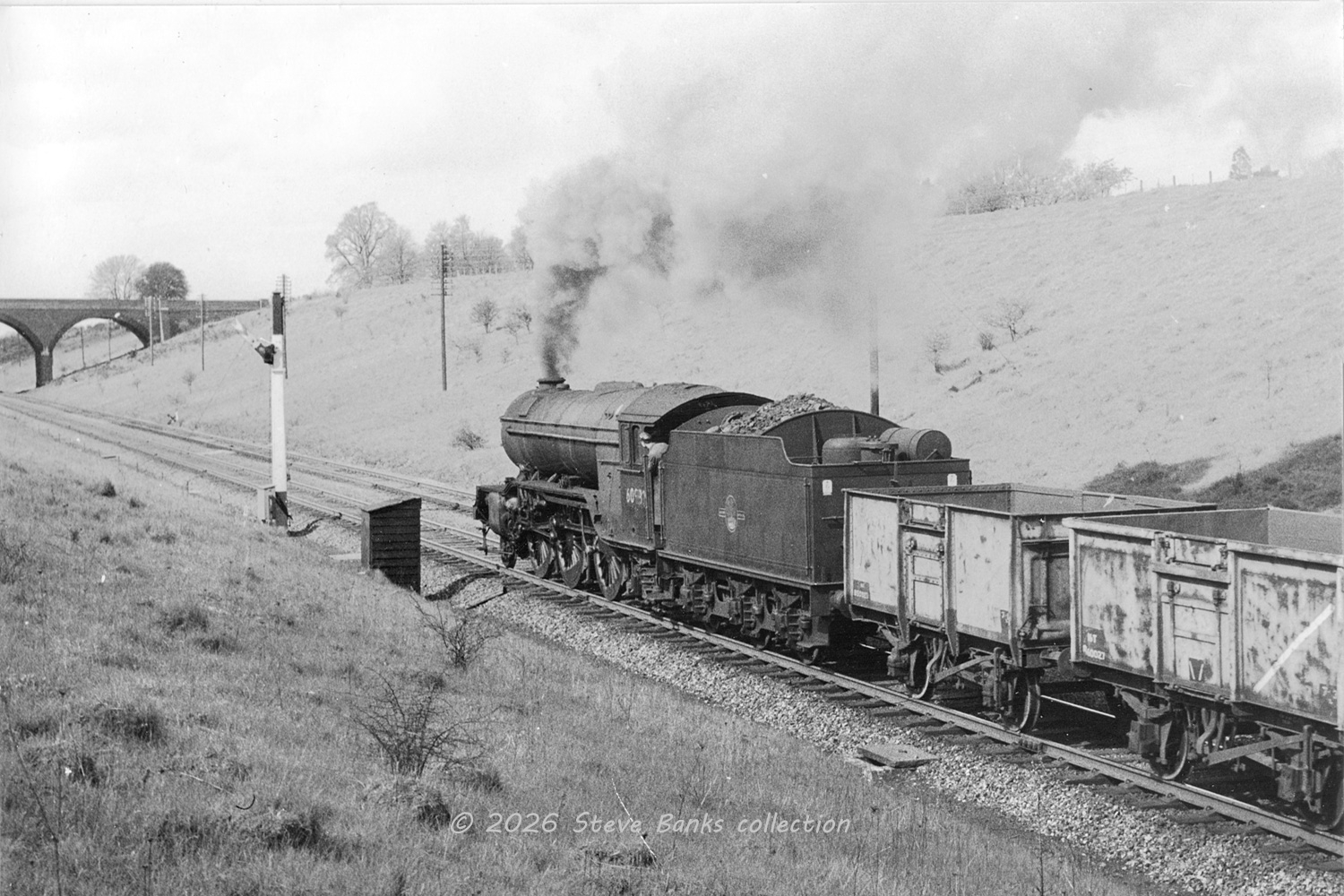
This Down train, also on the GCLE near Rugby Central c1963 and also headed by a mixed traffic V2, is useful for showing two steel mineral wagons of different designs. No 60932 was a York loco between 12/62 and 5/64 and an example of a York loco which had reached Woodford with an express freight and was being worked back with coal empties. Photo: author's collection.
Click on the image for an enlargement
6 - Grades of coal
These are all BR-period views but from higher angles by which the wide variety of coal moved by rail can be seen:

This picture at Thoresby Colliery in 1955 ran in the Model Rail article and I show it again to remind modellers of two aspects:
Firstly, the sheer variety of the grades of coal. In the distance two pitheads can be seen that were clearly reaching different seams of coal, from which coal merchants could offer many varieties to suit customers' choices and their pockets, of course. Photo: BR, author's collection.
Secondly, that although the steel mineral wagon had been been introduced before WW2, it took a long time to eliminate the wooden wagons and this mid-fifties picture shows a 50/50 mixture of both kinds, among which 7- and 8-plank wagons can be seen. Look closely and you'll even see a trio of 5-plank wagons.
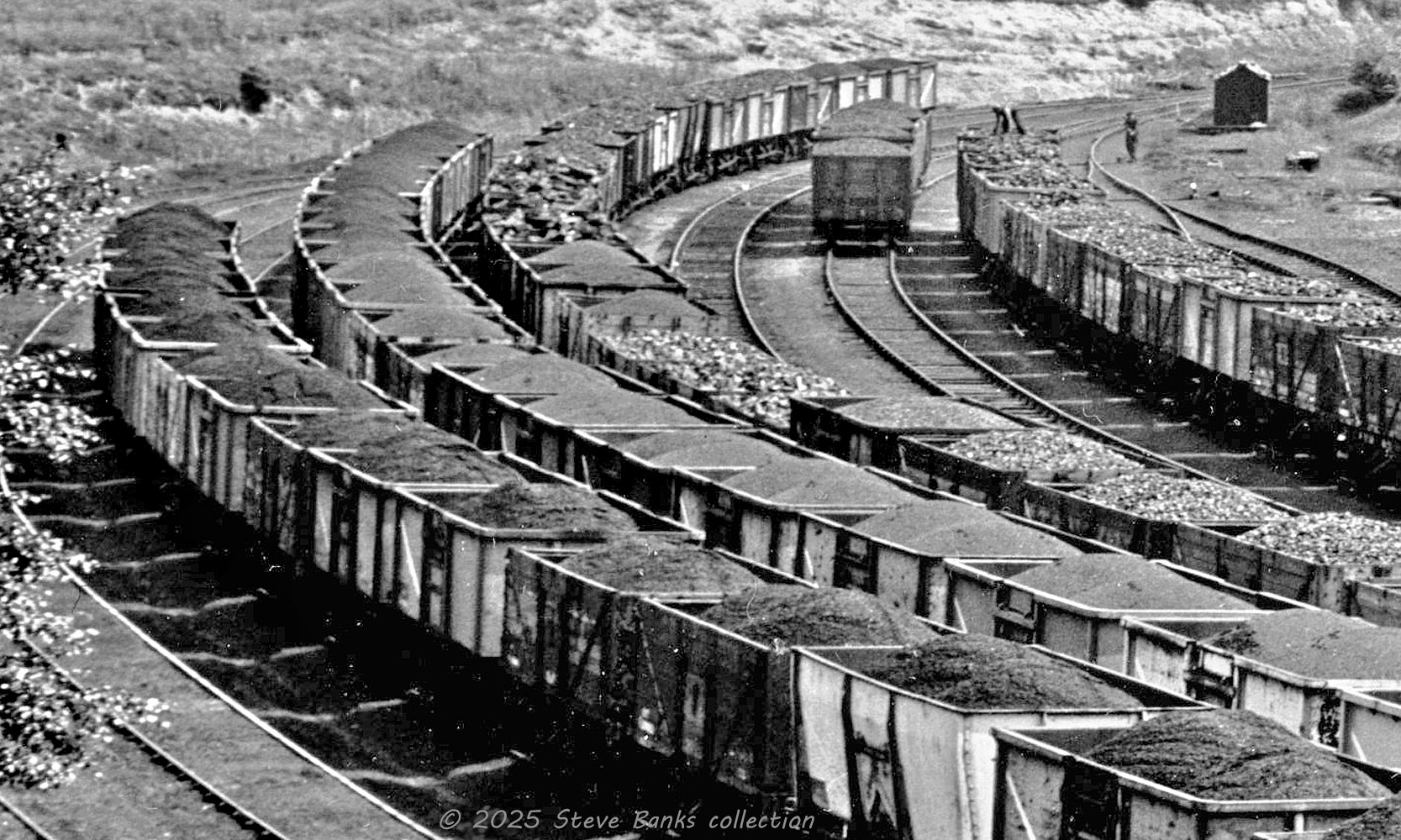
Note that the three 5-plank wagons have a different grade of coal to the surrounding wagons and may have been destined for one customer.
An interesting point is that all these wagons are freshly loaded and the coal in each wagon is quite high with a distinct pyramid.
Click on the image for an enlargement
The next three views illustrate what many modellers' interpretation of identical loads could benefit from!
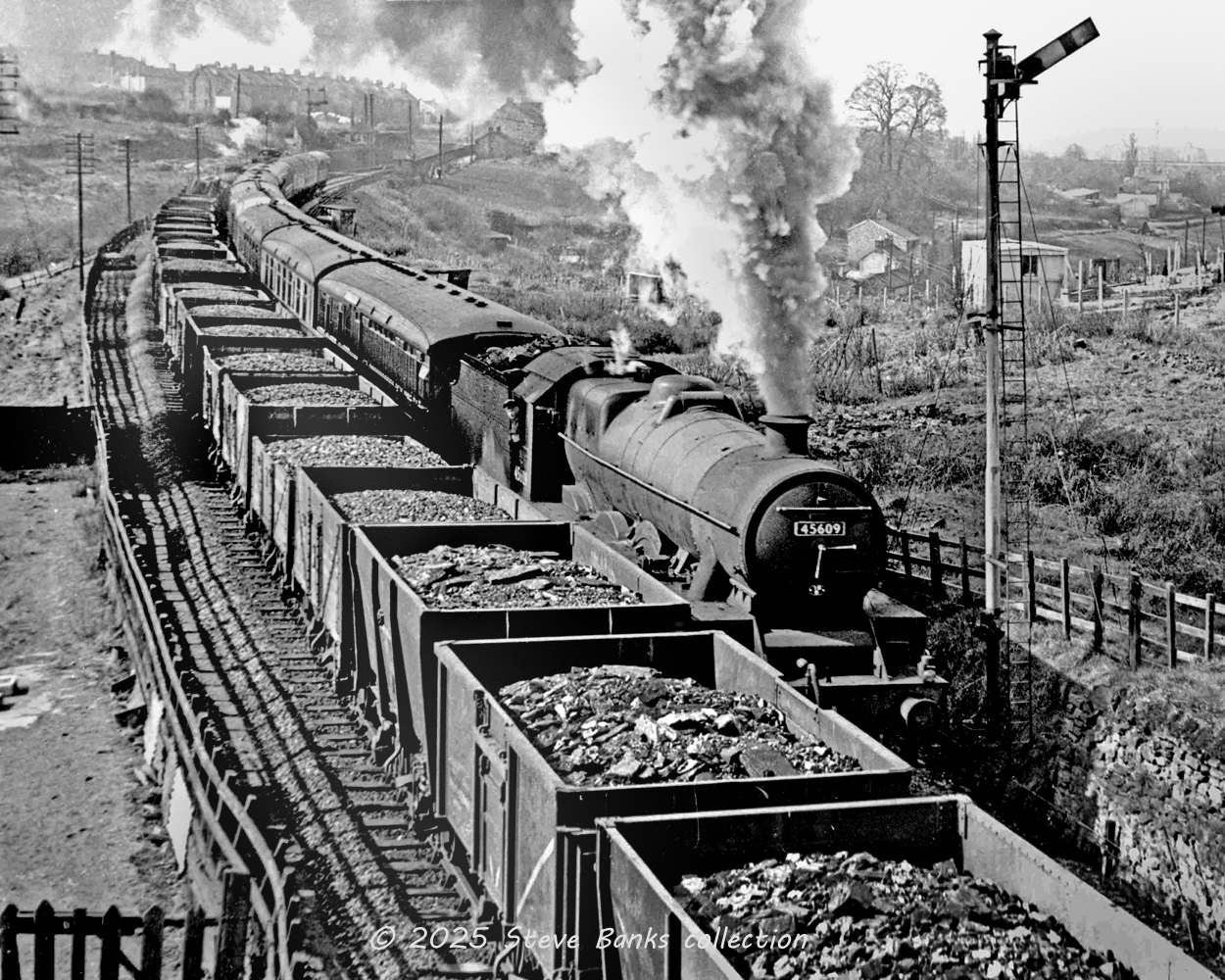
It's April 2nd 1951 and ex-LMS Jubilee Class 4-6-0 No.45609 Gilbert and Ellis Islands is passing a coal train at Kingswood in South Gloucestershire. Different grades of coal have been loaded to well below the top edge of the wagons, except for the 6-plank merchandise wagon which is overflowing. It was not unknown for wagons like this to find themselves in coal trains and they show in many photographs. Three wagons nearest the camera are carrying what may be a rough sorted industrial variety. Intriguingly, they are relatively modern steel mineral wagons.
Unlike a right variety of old wooden wagons in the next batch, all carrying quite finely sized coal. This may have been for an industrial user, although it's fair to say such a size became more popular for home fires - previously a large size with its ability to burn in a large open grate with minimal attention had been the height of luxury. Photo: ER Morten.
After travelling some distance, the loads in each wagon have flattened out, especially the finer grades. Loads with larger lumps weren't so affected. This I would suggest is how most coal trains looked.
Click on the image for an enlargement
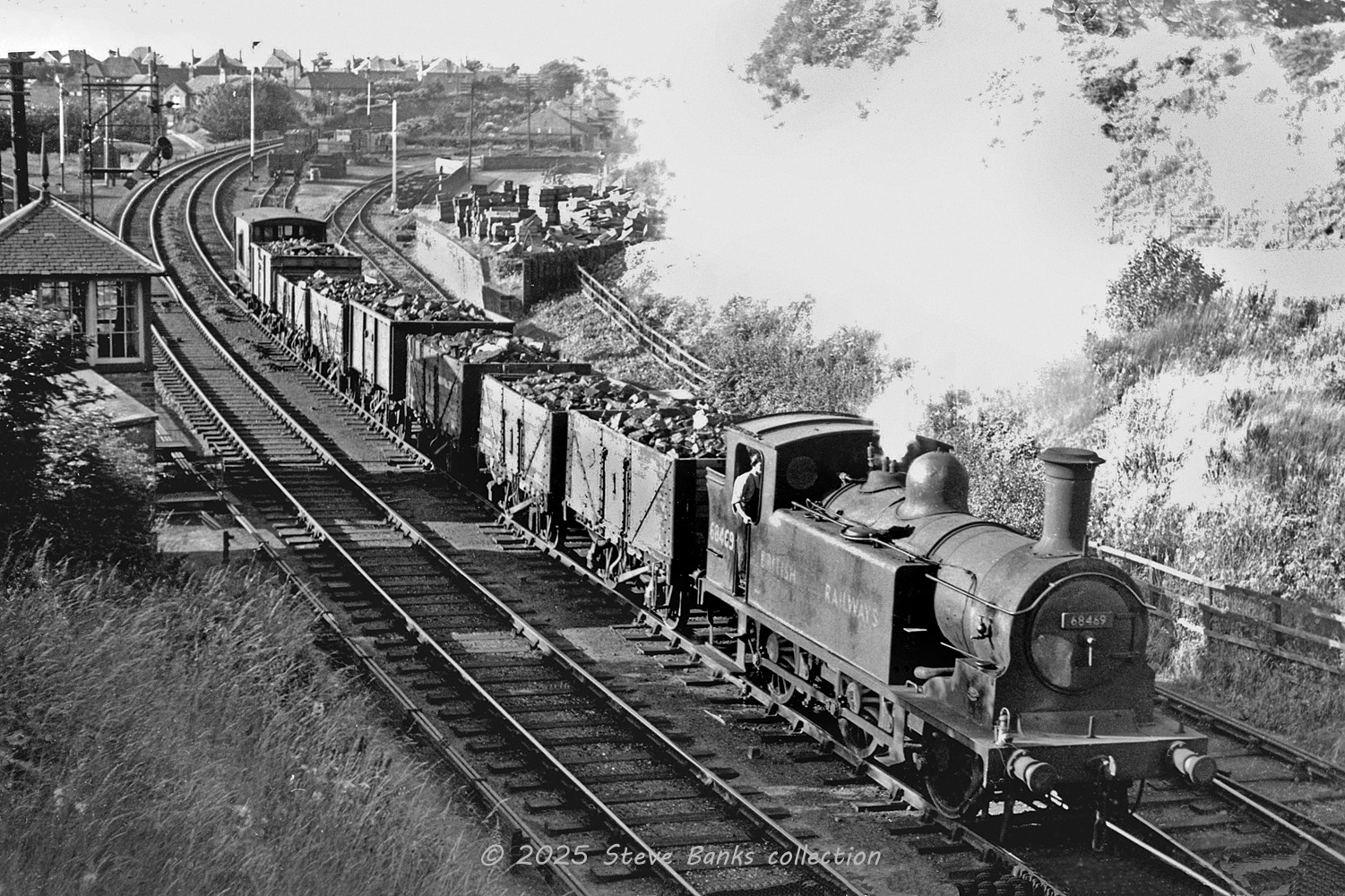
Another view from the early 1950s, 26th July 1952, as J83 No.68469 (St.Margarets) passes Craigleath signal box with a Class C (now Code J) short distance coal train in which all the wagons are carrying a decent quality of coal and best described as a trip working from north to south through Edinburgh. More relevant perhaps are the wagons:
5-plank |
1 |
7-plank & 8-plank |
6 |
steel mineral wagons |
2 |
The 5-plank merchandise wagon is visibly loaded with less coal than the other wagons and, in other words, there were 4 different types of wagon here of different lengths and heights - and marvellous to see. The steam railway was always a transition of old and new designs. Photo: authors collection.
Click on the image for an enlargement
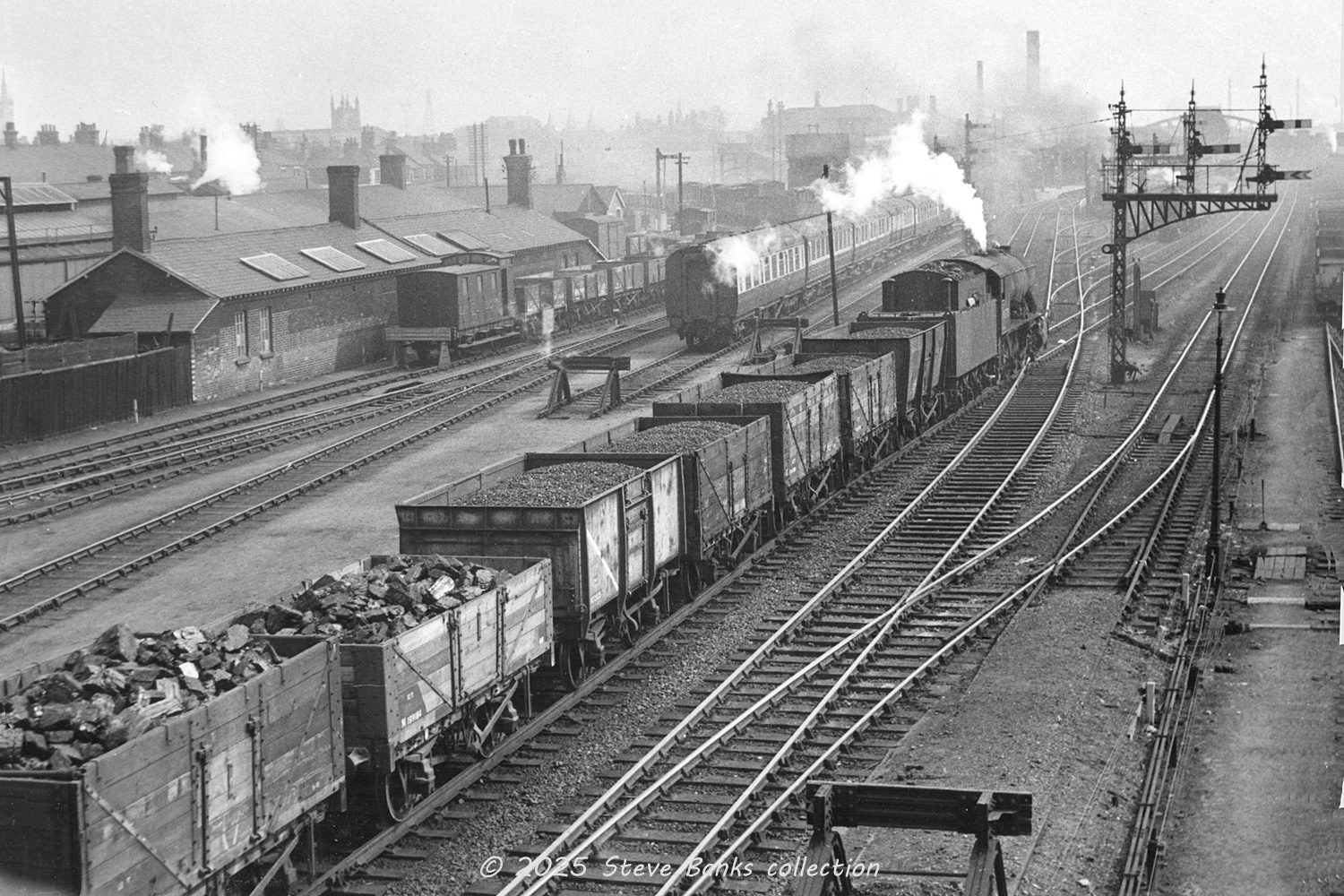
An unidentified WD 2-8-0 approaches Peterborough in July 1958 with an Up coal train. The wagons nearest the camera are carrying high quality domestic coal in large lumps. Note the merchandise ex-LMS 5-plank open, and that two of the four wooden mineral wagons are 8-plank, a type rarely "seen" by modellers. The contrast with the coal in the next five wagons could not be greater for they are carrying a finely divided grade which may be destined as fuel for kilns in the many brickworks which were established nearby.
It's also striking to see how the finer grades have flattened out, but not the larger lumps - they look very different. Photo: BR, author's collection.
Click on the image for an enlargement
- - - -

